
⚡ Motor Physics
Magnetic Fields & DC Motor Basics: How Current Powers Motion
Currents Create Magnetic Fields
When electric current flows through a wire, it creates a magnetic field around the wire. This fundamental principle was discovered by Hans Christian Ørsted (Danish physicist) in 1820, when he noticed a compass needle deflecting near a current-carrying wire. It linked electricity and magnetism, eventually leading to the development of electric motors, generators, and modern electromagnets!
The Right-Hand Rule
To predict the direction of the magnetic field around a current-carrying wire:
- Point your thumb in the direction of current flow (conventional current, + to −)
- Your fingers curl in the direction of the magnetic field lines
🖐️ Right-Hand Rule Demonstration
Straight Wire
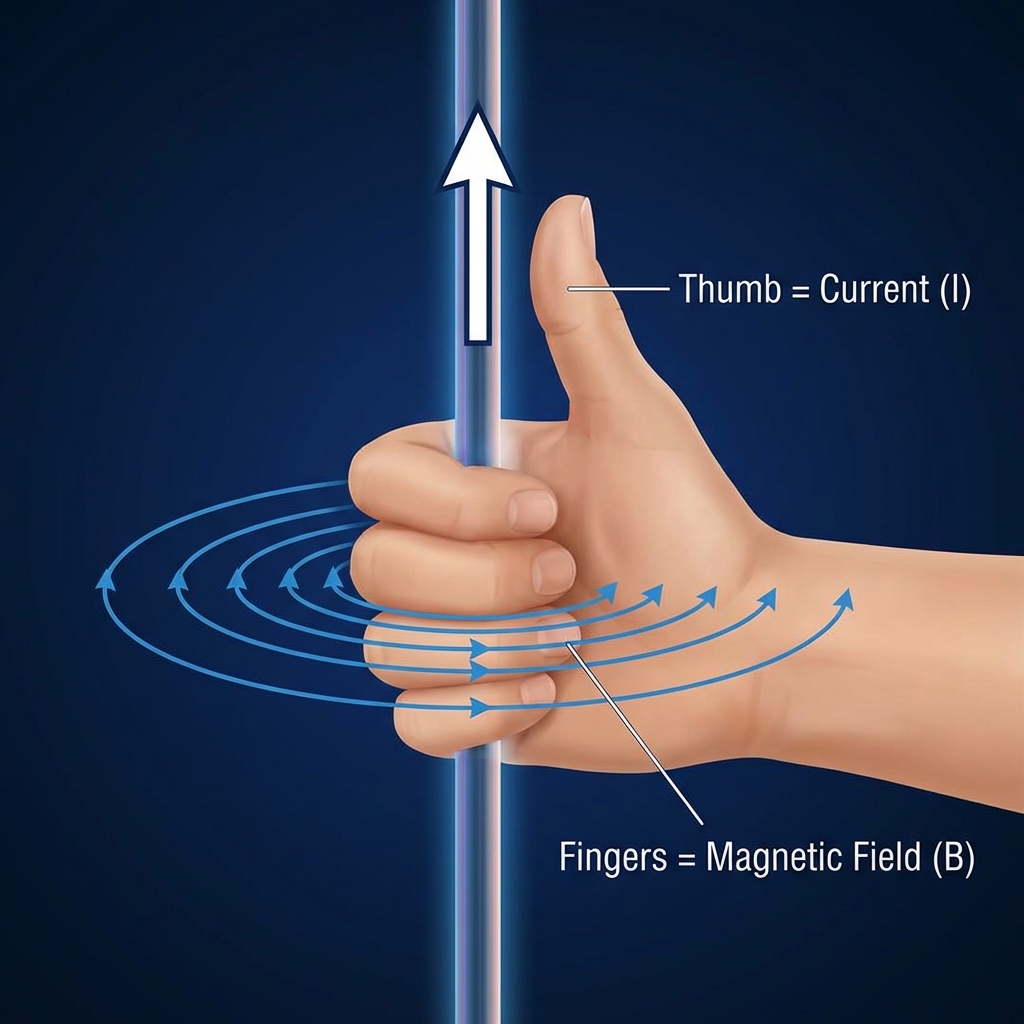
Thumb = Current direction (I)
Fingers curl = Magnetic field direction (B)
The magnetic field forms circular loops around the wire, getting weaker as you move away.
Current Loop/Coil
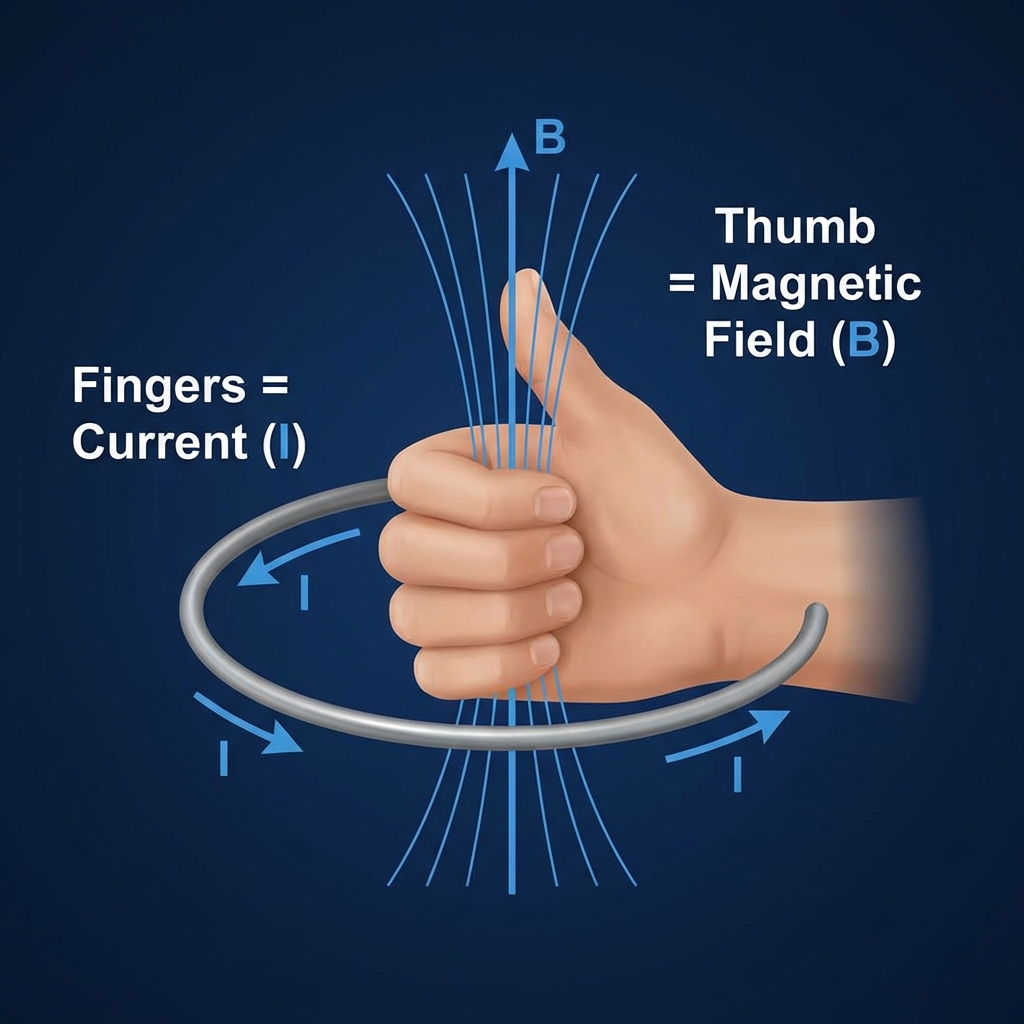
Fingers curl = Current direction (I)
Thumb = Magnetic field through center (B)
This is how motor coils work, current loops create magnetic poles!
📚 More About the Right-Hand Rule ▼
Why It Works
-
The right hand rule works because electricity and magnetism are naturally "locked" at right
angles to each other. Whether energy is flowing through a straight wire or a circular coil,
it always creates a magnetic field that loops or pushes in a very specific, predictable
direction. The right hand rule uses the shape of your hand to visualize those directions,
making the invisible patterns of physics easy to see and predict.
Different Variations
- Straight wire: Thumb = current, fingers curl = field direction
- Coil/solenoid: Fingers curl = current, thumb = field through center
- Force on a wire: Thumb = current, fingers = external field, palm = force direction
Real-World Applications
- Electric motors: Understanding field direction helps design efficient motors
- Generators: The same principle works in reverse; moving magnets create current
- Electromagnets: Predicting pole orientation for lifting magnets, MRI machines
- Speakers: Current through a coil creates force that moves the speaker cone
📐 Magnetic Field Formulas
These formulas let you calculate the strength of the magnetic field created by electric current. Understanding them helps predict motor performance and design better electromagnets.
Straight Wire
B = μ₀ × I / (2πr)B = field strength (T), I = current (A), r = distance from wire (m)
What it tells us: The magnetic field strength around a straight wire decreases as you move away from the wire (inversely proportional to distance). This is why the field is strongest right next to the wire.
Usage: Calculating field strength at any point near a current-carrying wire, used in cable design and interference calculations.
Solenoid (Coil)
B = μ₀ × μᵣ × N × I / LN = turns, L = length (m), μᵣ = relative permeability
What it tells us: The field inside a coil is uniform and directly proportional to current and number of turns. More turns or more current = stronger field. The core material (μᵣ) can multiply the field by a lot
Usage: This is the key formula for motor design, it tells us how to create strong magnetic fields for maximum torque.
Constants
μ₀ (permeability of free space) = 4π × 10⁻⁷ T×m/A ≈ 1.257 × 10⁻⁶ T×m/A
This is a fundamental constant of nature, it determines how easily a magnetic field forms in empty space (vacuum).
μᵣ (relative permeability): Air ≈ 1, Ferrite ≈ 2000, Iron ≈ 4000
This tells us how much better a material is at supporting magnetic fields compared to empty space. Iron is about 4000 times better than air, which is why motors use iron cores!
💡 Did You Know?
🧲 Earth is a Giant Magnet
Earth's magnetic field is created by electric currents in its molten iron outer core — the same concept as in electromagnets! It's about 25-65 microtesla at the surface.
🚄 Maglev Trains
Maglev trains use very strong electromagnets to levitate above the track! The Japanese L0 Series can reach speeds over 600 km/h using this technology.
🏥 MRI Machines
MRI machines use magnetic fields about 60,000 times stronger than Earth's field to create detailed images of your body — without radiation!
🔌 The First Electric Motor
Michael Faraday built the first electric motor in 1821, just one year after Ørsted discovered that currents create magnetic fields. It was very simple: just a wire dipping into mercury!
From Electricity to Motion
Now that you understand how currents create magnetic fields, let's put this into practice. In an electric motor, the strength of the magnetic field directly affects how much torque (rotational force) the motor can produce.
Why This Calculation Matters
When you're building or selecting a motor for your RC car, you need to understand:
- Stronger magnetic field = more torque — A motor with a stronger field can push harder against resistance, letting your car accelerate faster or climb hills
- More current = stronger field — But more current also drains your battery faster and generates more heat
- Core material matters — Using iron or ferrite instead of air in the motor core multiplies the magnetic field strength by a large factor
- Trade-offs — More coil turns increase field strength but also increase resistance (meaning more voltage needed)
The simulator below lets you experiment with these variables to see how they affect motor performance.
🔧 Motor & Magnetic Field Simulator
DC Motor Simulator
Magnetic Field Visualization
Motor Speed Estimate
⚠️ Approximate educational estimate only
Results
📝 Show Step-by-Step Work ▼
Adjust inputs above to see calculations.
🔄 How DC Motors Work
The Basic Principle
A DC motor converts electrical energy into rotational mechanical energy through the interaction of magnetic fields:
- Current flows through the motor's coil (armature)
- The current creates a magnetic field around the coil
- This field interacts with permanent magnets in the motor housing
- The interaction creates a force that causes rotation
- A commutator reverses current direction each half-turn to maintain rotation
Note: Detailed torque calculations are more complex. The motor speed is approximately proportional to voltage and inversely related to load.
📚 Technical Note: Back-EMF ▼
Back-EMF (Counter Electromotive Force)
As the motor spins, it acts like a generator and produces a voltage that opposes the supply voltage. This is called back-EMF.
- At startup: No rotation → no back-EMF → high current (limited by resistance)
- At speed: High rotation → high back-EMF → reduced current
- Under load: Motor slows → less back-EMF → more current to overcome load
This explains why motors draw more current when starting or under heavy load.
Vsupply = I × R + Vback-EMF📖 Worked Examples
Example 1: Solenoid Magnetic Field
Problem: Calculate the magnetic field at the center of a solenoid with 200 turns, length 5 cm, carrying 2 A, with an air core.
Show Solution ▼
Given: N = 200, L = 0.05 m, I = 2 A, μᵣ = 1
B = μ₀ × μᵣ × N × I / L
B = (4π × 10⁻⁷) × 1 × 200 × 2 / 0.05
B = 1.005 × 10⁻² T = 10.05 mT
Answer: B ≈ 10 mT
Example 2: Motor Current from Battery Pack
Problem: A 4×AA pack (6V) powers a motor with 3Ω resistance. The batteries have 1.2Ω total internal resistance. What current flows?
Show Solution ▼
I = V / (Rmotor + Rinternal)
I = 6 V / (3 Ω + 1.2 Ω)
I = 6 / 4.2 = 1.43 A
Answer: I ≈ 1.4 A